Showing posts with label research. Show all posts

Friday, 29 October 2010

Promotion of ARCH event

Promotion of the ARCH event in community centres

Today I went to Leeds to tie up a few loose ends, speak to some community centre representatives and promote the ARCH event to local enterprises. Whilst doing this, I was speaking to a representative of the Woodhouse Community Centre who was enthusiastic about the work we are doing and that evening was meeting representatives of the LUU to discuss volunteer dispersion throughout the ward, she then offered to out discuss the work we are doing with the university activity groups in relation to possible voluntary activity within All Hallows. During this discussion we talked about some of All Hallows members joining the 'community transformers' scheme which she stated would be the most sensible step for All Hallows in relation to the implementation and progression of the live project.

Monday, 25 October 2010

Voluntary Action Leeds

Doing some contact research for All Hallows I have come across an organisation called Voluntary Action Leeds who provide funding assistance for Voluntary Community Faiths Sector organisations (of which All Hallows is) along with paid training events such as fundraising, governance; management, skills development, volunteering, finance, employment along with providing help on finding volunteers within the area. They seem like an organisation we should make the PCC aware of as membership would be free to the community centre side of the church.

Sunday, 24 October 2010

Documentation of community centre activity

A list of the current provision of social activities within the area from the various centres. Some interesting thoughts can be had from this as all other community centres have significantly more staff than All Hallows (20 - 40 members generally), of which the majority are full or part time staff. It suggests one of three things to me (or quite possibly a combination of the three),
  1. All Hallows is overstretching their limited resources by providing a plethora of activities or,
  2. the activities provided are quite unique in the area and therefore are not advertised adequately or,
  3. the community is unresponsive to this provision of these activities


There does seem to be a lack of creative resources in the area, a distinct lack of greenery in the urban realm (therefore no gardening skills or requirement thereof), no knitting circles, no public art, a lack of cultural facilities and as Li commented, no cooking or baking classes.

Business plan example?


From the heated discussion on Friday about, who pays for the resource? All or none, the Woodhouse Community Centre has an interesting business model which is worth a quick peek, where some pay for membership to certain classes, others use the facilities for free, some volunteer for work on a casual and long term basis whilst others, permanent staff are paid flat rate per hour.

Skills sharing

© John Ward : Woodhouse Community Centre Leeds _ Gardening Collective

I was just thinking that possibly we should be considering the skills sharing as a tool for engagement with other community and religious organisations? If a member or members of the All Hallows was capable and willing to participate in an event such as the "Community Transformers Scheme" (looking at how to undertake community research, consultation and organisational strategies) in the Woodhouse community centre they would have more empathy to this centre and also gain National accreditation in community development. From this All Hallows could then collaborate with Woodhouse Community Centre or form its own scheme for environmental, social and economical sustainability. Seems pretty sensible and would fit into a longer term vision for skills sharing and networking of the community centre.

Saturday, 23 October 2010

Network simplification

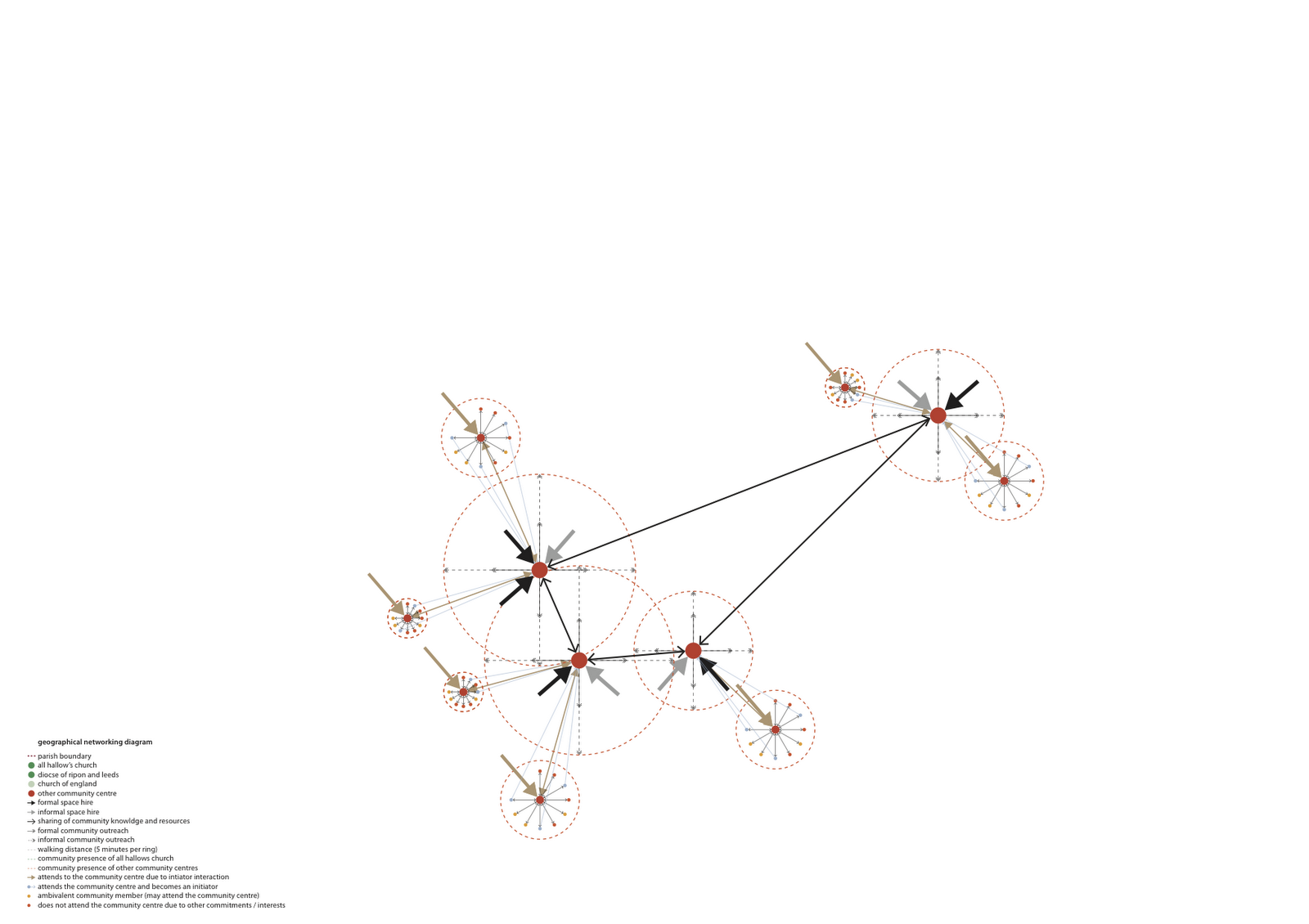
Any views /objections to these simplified networking diagrams, layout, legibility of diagrams, amount of information etc.?


Thursday, 21 October 2010

Case study for our scheme?

Self perpetuating organisation in Leeds that previously was a church.
Very similar to what we perceive All Hallows to be, in that the church wished to retain its spirtual significance whilst opening its doors, freely to the public to use the building as an artistic and creative resource.

"This project is focused on producing a business plan, with four strands of activity, which can be developed. The business plan reflects the goal to operate without a reliance on grants, but there is an acceptance that grant funding will be required to undertake the necessary alterations to the building to turn it into a viable arts venue...The arts activities have helped to raise the profile of the church in the community and they demonstrate how open and accessible the church venue is for everybody"

Wednesday, 20 October 2010

Networking diagram

Just to keep everyone informed, i am making some adjustments to the networking diagrams and including the religious networks onto some of these, initially understanding their individual organisational networks and then overlaying them upon a abstract geographical base. This will then be extended to include those centres who are willing to engage with us on a broad community level. It seems to be going well so far.
Religious and community organisations positioning
Religious and community organisations willingness to engage with the project (so far)
All Hallows Church religious interaction
All Hallows Church community interaction


The intention is to compile these onto a few pages for knowledge of who to engage in the process and also for a future networking proposal.

Tuesday, 19 October 2010

Walk of friendship

Interfaith and community group solidarity event in Leeds, in which All Hallows participates.

"Saturday 01st May 2010, members of the community from various cultural and religious backgrounds joined together as 'one' for the Walk Of Friendship, to walk through some of the streets of Leeds, with paying visits to spiritual sites and places of worship."

Friendface

Christmas has come early guys...All Hallows are on Friendface. It seems relatively inactive though (one post every month or two) and is used to publicise specific religious and social events, almost separately as there is another friendface group for the live acoustic nights.

It seems like a tool for ex-congregation members to remain in contact with the worshipping community.

Great quote from the group wall :

"Happy memories with my children there we used to cycle to church like a family of ducks in a row"

Sunday, 17 October 2010

Design Workshop Day 2

After an eventful and productive first day we began setting up the tasks for further user participation through re-configring the car park. To do this we temporarily placed some of the cafes furniture upon the expansive asphalt drive way. The purpose of this task was to determine the reaction of the worshipping community to the alteration of traditional procedures.

We then participated as a group in the church service, assimilating ourselves into the rituals of the worshipping community. After this, we all had some tea and coffee on the car park and had some interesting conversations with old and young members of All Hallows Church.


Site participation tool, extending the cafe to the car park and engaging the worshipping community

Conclusion = Exhaustion


Some tired campers...bless their wee cotton socks

Design Workshop Day 1

Today saw the commencement of a two day intensive design workshop within All Hallows Church. The was design to focus our understanding of where the project was going and also to imbed us into the cultural and religious positioning of the church through active engagement of the building users and having a presence within the community / site / building


Community participation tool, posting flyers at specific locations

The day started with the community group descending upon three agreed areas of the ward to informally understand the communities knowledge of the whereabouts of All Hallows. This exercise proved interesting through its verbal application, although less successful (over two days) in its informal documentation as the results gathered were sparse and unhelpful, in saying this, it was insightful as it demonstrates that public members are aware of the urban environment although passive about interacting with it, therefore the exercise was beneficial in providing a better community understanding


Design development, focusing the design approach to specific areas for progression

Whilst the community exercise was undertaken the remainder of the group began recording the initial stage of the matrix (all of the current issues of the design). We then discussed this a collective and began distilling the information into areas of potential focus through voicing the clients interest along with our individual interests. This was assembled through asking four key questions :
  1. What is of most important to the client?
  2. What is of most importance to us?
  3. What will be most beneficial for All Hallows?
  4. What is the most achievable?

By doing this we then consolidated the information of the matrix into areas of importance based on the question posed, these being :


Question 1 - What is of most important to the client?
  • Building users
  • Funding
  • Ethos
  • Storage and the practical use of the space
  • Visibility of activity

Question 2 - What is of most importance to us?
  • Organisational networking
  • Internal / external connectivity
  • Signage

Question 3 - What will be most beneficial for All Hallows?
  • Visual appearance
  • Funding
  • A sustainable business model (increasing the buildings activity)
  • Internal / external connectivity

Question 4 - What is the most achievable?
  • Increasing the buildings activity
  • Signage (communication of the activity and visibility of activity)
  • Alteration of the cafe area
  • Sustainable food sourcing
This was then consolidated into THREE KEY THEMES :

  1. New users of the building through social connectivity and networking
  2. Communication of the buildings activity (signage, ethos, presence etc.)
  3. Connectivity of spaces internally / externally and the practicality of building uses

After this, we assessed strategies for analysing developing these three themes looking at specific design tasks.

The physical team then interacted with the activity groups within All Hallows through asking a series of poignant questions which were to be answered in a jovial way, through writing upon the back of each team member. This proved very successful as the users responded to the participation tool with a sense of conviviality

Physical participation tool, getting the building users opinion

"...and they hopefully gazed upon what made...and it was good..."

Wednesday, 13 October 2010

Client meting 02

Inspirational messages within the creche

The presentation to a critical audience

Today was the groups second chance to meet the client team and present work in progress up to this point, proving to be encouraging, insightful and uneasily docile from the client. Some of the more telling points from the meeting (in no particular order) were;

  1. the building is seen as a hub and want people to come here and want to attract people there to use the building
  2. All Hallow's Church has tenuous connections with the other local community centres but wish to strengthen relationships with these other community and religious centres
  3. we should consider the duality of approaches to the building (front and back facias)
  4. wishes to make visible the activity within the building to the outside
  5. building should be considered to have a fluidity of movement patterns and overlapping of uses
  6. the 'greening' of the building should be considered as a tool of engagement with the community
  7. skill sharing of the building and community users should be explored in more depth to help place with building within a community context
  8. considering the site boundary as a 'green island'
  9. enjoys the play of light within and around the building

Project deliverables and progression were;

  1. the production of a strategic funding document to aid grant applications and a future visioning of the organisation, starting small and gradually growing to more extreme propositions
  2. exploration of religious networks to All Hallow's Church
There was a general consensus that the problems the church currently faces are much bigger than just the physical maintenance, but also includes social engagement and outreach as the congregation is quite isolated due to their radical viewpoints.

"Leave the religion to us"
Steve - All Hallow's Church 2010

Sunday, 10 October 2010

Impromptu site meeting

Sacred Wing practicing within the main hall

During site and community centre research today I bumped into Steve whilst photographing the front facade and was invited to meet and converse with a choral group (sacred wing) who were practicing for the All Hallows Church Christmas Service. I had a chance to speak with the group prior to practice and some comments from the discussion were;

  • none of the choral group were part of the worshipping community
  • All Hallows was seen as a community hub where the faith element was down played
  • there is not enough natural or artificial lighting to illuminate a musical score
  • sunlight through the main window of the hall was used as a gauge for the passing seasons
  • most members arrive via car-sharing therefore the car-park is a valuable resource for this activity group
  • thought that the administrative areas of the building were cold and unfriendly

Networking Diagrams

Some updated business and social networking diagrams as an elaboration to the previous stakeholder diagrams. The purpose of these diagrams is to provide an understanding of the business and social context of All Hallow's Church. It should be understandable but through the overlaying of information although the information does become dense.

All Hallow's Church business and social networking

Current community centre business and social co-operation

Local community centres business and social networking

Friday, 8 October 2010

Community centre investigation

After this afternoons meeting with Trish and Simon and the physical activity that ensued, I visited the community centres within walking distance of All hallow's Church, spoke to some of the users and staff of these buildings, documented their physical presence within the community and the welcome received from each, these brief encounters proved incredibly insightful. I will disclose the information gathered at the meeting on Monday. Below is a snippet of the information gathered which can be interpreted without any explanation.

All Hallows Church noticeboard


Cardgian Centre noticeboard(s)


I was unable to enter the Burley Lodge Youth Project due to activities within the building, although stopped and spoke to some of the lingering users outside of the building, whilst the Woodsley Road Multicultural Centre was closed for the entirety of today.

Thursday, 7 October 2010

Security of the building


MaccreanorLavington - Weert

Sarah, Vas and myself were speaking earlier of the possibilities for alterations to the window grills and we were wondering if the grill becomes some form of artistic statement. Built examples of this would be MaccreanorLavingtons project in Weert, Netherlands or it could be something more Parisian and take the form of sculpted ironwork.

Random building and tree base in Paris

Altering perceptions

Stadtlounge St.Gallen

Stadtlounge in St.Gallen was created by Carlos Martinez Architects and artist Pipilotti Rist as a piece of public art within the urban realm, it is a pedestrianised area of the city centre that was designed to represent a lounge within the street environment, thus making people interact differently with the object around them and perceiving their environment in a unique and unaccustomed manner.


Stadtlounge St.Gallen

Monday, 4 October 2010

Park(ing) Day and Tinwolf


I realise that they sound like a pair of catchy new superheroes but...no!
The Park(ing) Day event is undertaken on a worldwide platform, in the majority of major cities, the participant in the UK is not London but...Leeds.The purpose of the event is to temporarily increase the ratio of provided public space by reclaiming unused, underdeveloped and undesirable functions of the city and re-appropriating them with a desirable green park / space based on the idea of 'guerrilla gardening' of the city.


On a slight tangent from this, I have unearthed an community based organisation called Tinwolf, its ethos is to 're-invent the city through creating community solutions for a sustainable Leeds. It does seem a bit 'radical' (they have their own constitution) which may suit the desires of the church and they have an association with the University of Leeds and seem to attract student and community interest and play an active role in community engagement through the formation of activities and events. More knowledge is required. The blog for this organisation is here.

Friday, 1 October 2010

Mapping techniques


Some interesting examples of data visualisation, both interactive maps and mapping of large swathes of data can be seen through the work of Radical Cartography. This is well worth having a look through for inspiration and also some quirky examples of mapping manipulation by an artist called Shannon Rankin, her Maps Series (of which this is only part) is well worth a visit and could prove interesting for visual representation.

Do we need a large format map for every member of the facility within a week to pin on where they have come from? Could be a form of invisible interaction with the buildings participants.